pg_describe
A PostgreSQL function that replicates psql’s \d and \d+ commands in pure SQL - returning the relation descriptions as a regular result set you can query from any SQL client.
Why?
Postgres has \d name in psql, but you can’t call it over a regular SQL connection - a GUI, a notebook, an application, or anywhere else that just speaks SQL. pg_describe fills that gap with the same output, the same pattern syntax, and the same verbose mode.
Installation
psql -d mydb -f pg_describe.sql
Usage
-- List all visible user relations  (\d)
select * from pg_describe();

-- Describe a single relation
select * from pg_describe('public.orders');
select * from pg_describe('orders');           -- visibility search, like \d

-- Wildcard patterns  (\d cust*)
select * from pg_describe('cust*');

-- Schema patterns
select * from pg_describe('hr.*');             -- all objects in hr schema
select * from pg_describe('*.employees');      -- employees in any schema
select * from pg_describe('*.*');              -- everything in the database

-- Verbose mode  (\d+)
select * from pg_describe('orders', true);
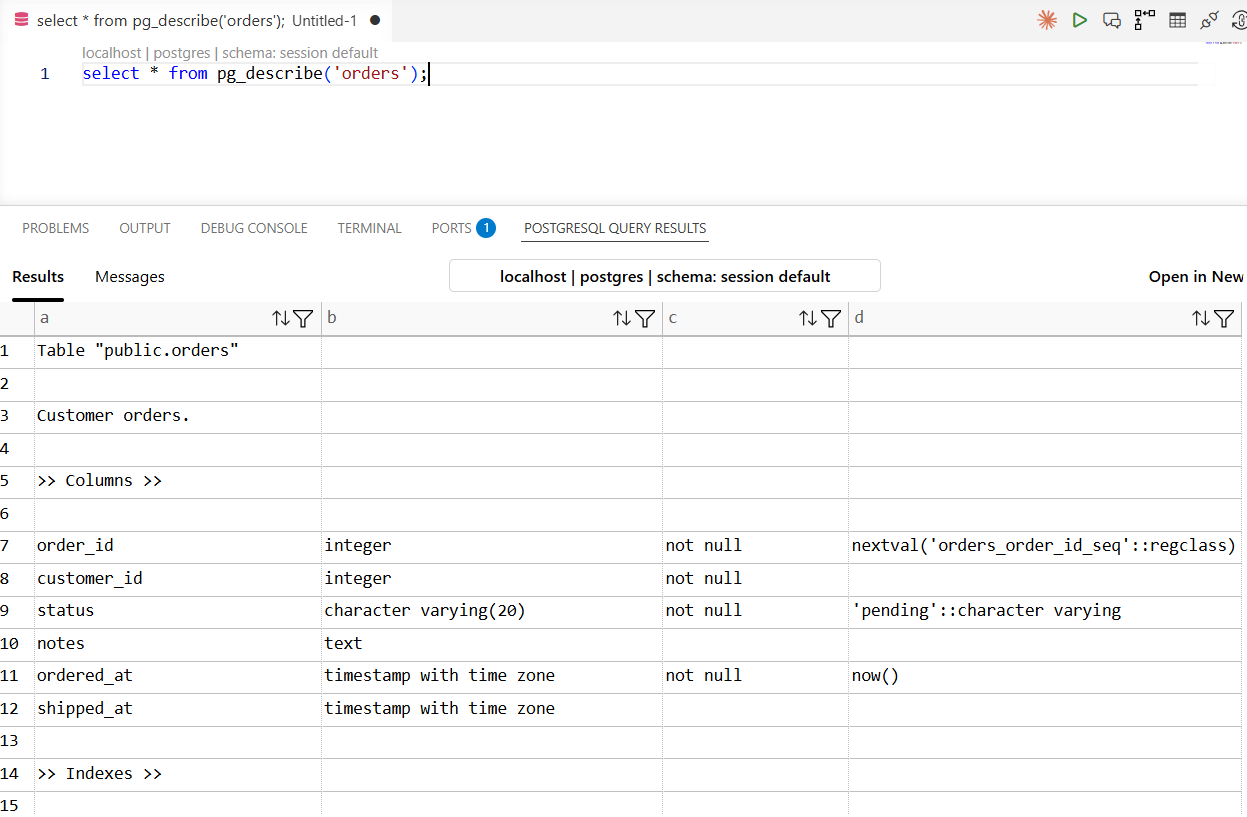
Screenshot
Pattern rules
Pattern syntax mirrors psql:
| Pattern | Meaning |
|---|---|
* |
any sequence of characters |
? |
any single character |
"quoted" |
case-sensitive literal (* ? . treated as plain chars) |
schema.name |
match by schema; no visibility filter |
name (no dot) |
match visible relations only |
*.* |
all objects in all schemas (including system) |
Unquoted characters are folded to lower-case before matching, so ORDERS, Orders, and orders all find public.orders.
Output
Four text columns (a, b, c, d). With no argument, returns a listing:
| a | b | c | d |
|---|---|---|---|
| schema | relation name | type | owner |
With a pattern, returns full descriptions. Sections vary by relation type:
| Section | a | b | c | d |
|---|---|---|---|---|
| Title | Table "schema.name" etc. |
|||
| Columns | name | type | not null / `` |
default |
| Indexes | definition | |||
| Check constraints | name | definition | ||
| Foreign-key constraints | name | definition | ||
| Referenced by | table | constraint | definition | |
| Triggers | name | timing + level | events | function |
| Partition key (partitioned) | definition | |||
| Server (foreign table) | server name | |||
| Sequence properties | property | value |
Verbose mode (true) adds:
| Section | a | b | c | d |
|---|---|---|---|---|
| Column details | name | storage | stats target | comment |
| Not-null constraints | name | definition | ||
| Definition (views) | SQL line | |||
| Access method | Access method: heap |
Relation types
pg_describe handles all eight relation types that \d covers:
| Type | relkind |
|---|---|
| Table | r |
| Partitioned table | p |
| View | v |
| Materialized view | m |
| Sequence | S |
| Index | i |
| Foreign table | f |
| Composite type | c |
Requirements
PostgreSQL 14-18 or later, no extensions are required.
Testing
Requires pgTAP. Load the schema and run:
make setup
make test
Linting
Requires plpgsql_check. Analyses the PL/pgSQL function bodies for type mismatches, unused variables, and invalid embedded SQL:
make lint
Examples
The tests/test-schema.sql file contains a sample schema (two schemas, seven tables, three views, three triggers, a partitioned table, a foreign table, and a composite type):
psql -d mydb -f pg_describe.sql
psql -d mydb -f tests/test-schema.sql